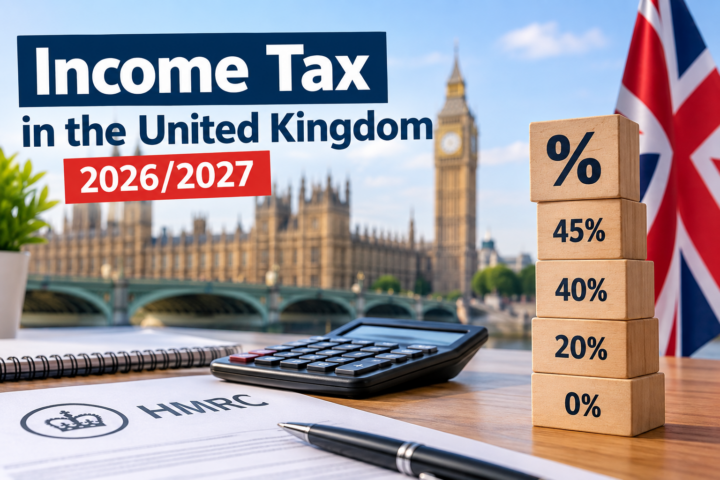
Income Tax in the United Kingdom is a progressive tax. This means that as your income increases, part of your earnings may be taxed at a higher rate.
However, moving into a higher tax band does not mean that all of your income is suddenly taxed at the higher rate. You only pay the higher rate on the part of your income that falls within that band.
The 2026/2027 tax year runs from 6 April 2026 to 5 April 2027.
Personal Allowance
The standard Personal Allowance for the 2026/2027 tax year is £12,570.
This means that most people do not pay Income Tax on the first £12,570 of their annual income.
Different rules apply to people with higher incomes. If your adjusted net income is above £100,000, your Personal Allowance is reduced by £1 for every £2 of income above that amount.
If your income reaches £125,140 or more, your standard Personal Allowance is reduced to zero.
Income Tax bands for 2026/2027
For people living in England, Wales and Northern Ireland, the main Income Tax bands are:
| Annual income | Income Tax rate |
|---|---|
| Up to £12,570 | 0% |
| £12,571 – £50,270 | 20% |
| £50,271 – £125,140 | 40% |
| Over £125,140 | 45% |
Scotland has different Income Tax bands and rates.
How do the tax bands work?
Let us assume that an employee earns £30,000 during the tax year.
The first £12,570 is covered by the Personal Allowance and is not taxed.
That leaves:
£30,000 – £12,570 = £17,430
The whole amount falls within the 20% basic rate band.
The Income Tax due would therefore be:
£17,430 × 20% = £3,486
This is a simplified example covering Income Tax only. National Insurance is calculated separately.
Example: earning £60,000 a year
If you earn £60,000 a year, you still receive the standard Personal Allowance of £12,570.
The first £12,570 is tax-free.
The next £37,700 is taxed at 20%:
£37,700 × 20% = £7,540
The remaining £9,730 falls into the 40% tax band:
£9,730 × 40% = £3,892
The total Income Tax would therefore be approximately:
£11,432
Again, this example covers Income Tax only and does not include National Insurance or any other allowances or deductions.
What income is subject to Income Tax?
Income Tax may be payable on:
- earnings from employment,
- profits from self-employment,
- some state benefits,
- the State Pension and most other pensions,
- rental income,
- some benefits provided by an employer,
- savings interest above your tax-free allowances,
- dividends above the Dividend Allowance.
Not every type of income is taxable.
Income from self-employment
People who are self-employed may be able to use the Trading Allowance.
The first £1,000 of qualifying gross trading income may be covered by this allowance.
If your income exceeds the relevant limits, you may need to register with HMRC and report your income through Self Assessment.
Tax on savings interest
Not all interest earned from savings is taxable.
For the 2026/2027 tax year, the Personal Savings Allowance is:
- £1,000 for basic rate taxpayers,
- £500 for higher rate taxpayers,
- £0 for additional rate taxpayers.
For example, a basic rate taxpayer can usually receive up to £1,000 in savings interest without paying additional tax on it.
People with lower incomes may also benefit from the Starting Rate for Savings, which in some circumstances can allow up to £5,000 of savings interest to be received tax-free.
ISA accounts
Savings and investments held inside an ISA are subject to separate tax rules.
Interest, income and investment gains held within an ISA are generally free from Income Tax and Capital Gains Tax.
In the 2026/2027 tax year, you can pay up to £20,000 in total into eligible ISA accounts.
Tax on dividends
If you own shares in a company or are a shareholder in your own Limited Company, you may receive dividends.
For the 2026/2027 tax year, the Dividend Allowance is £500.
Dividends above this amount may be taxable.
The dividend tax rates for 2026/2027 are:
| Tax band | Dividend tax rate |
|---|---|
| Basic Rate | 10.75% |
| Higher Rate | 35.75% |
| Additional Rate | 39.35% |
Dividends from investments held within an ISA are not subject to dividend tax.
Renting out a room in your home — Rent a Room Scheme
If you rent out a furnished room in your main home, you may be able to use the Rent a Room Scheme.
The scheme allows you to receive up to £7,500 a year tax-free.
If the rental income is shared with another person, the allowance is usually split, giving each person a limit of £3,750.
If your income does not exceed the allowance, the exemption is usually applied automatically.
Other tax-free income
You do not normally pay Income Tax on:
- income and interest held within an ISA,
- some state benefits,
- National Lottery winnings,
- Premium Bonds prizes,
- qualifying income covered by the Rent a Room Scheme,
- the first £1,000 of qualifying trading income under the Trading Allowance,
- the first £1,000 of qualifying property income under the Property Allowance.
Some state benefits are taxable
It is important to remember that not every benefit paid by the government is tax-free.
Benefits that can count as taxable income include:
- State Pension,
- Jobseeker’s Allowance,
- Carer’s Allowance,
- some types of Employment and Support Allowance.
Common benefits that are generally not subject to Income Tax include Universal Credit, Personal Independence Payment (PIP), Housing Benefit and Disability Living Allowance.
How is Income Tax paid?
Most employees do not need to send Income Tax payments directly to HMRC.
Their employer deducts the tax through the PAYE — Pay As You Earn system.
Your payslip will normally show:
- gross pay,
- Income Tax,
- National Insurance,
- pension contributions,
- net pay.
The amount of tax deducted depends partly on your tax code.
People who are self-employed, receive significant untaxed income or fall into certain other categories may need to complete a Self Assessment tax return.
Income Tax and National Insurance
Income Tax and National Insurance are two separate charges.
Depending on the type and level of your income, you may pay one, both or neither.
For this reason, when looking at a payslip, it is worth remembering that not all deductions are part of Income Tax.
Summary
The UK Income Tax system may look complicated at first, but the basic principle is fairly straightforward.
Most people receive a Personal Allowance of £12,570, which means Income Tax is usually charged only on income above that amount.
Moving into a higher tax band also does not mean that all of your income is taxed at the higher rate. The higher rate applies only to the part of your income that falls within that band.
It is worth checking your tax code and the information held on your HMRC account regularly, especially after changing jobs, receiving a pay rise or starting to receive income from an additional source.
The figures in this article apply to the 2026/2027 tax year. Tax rules and allowances may change in future tax years.