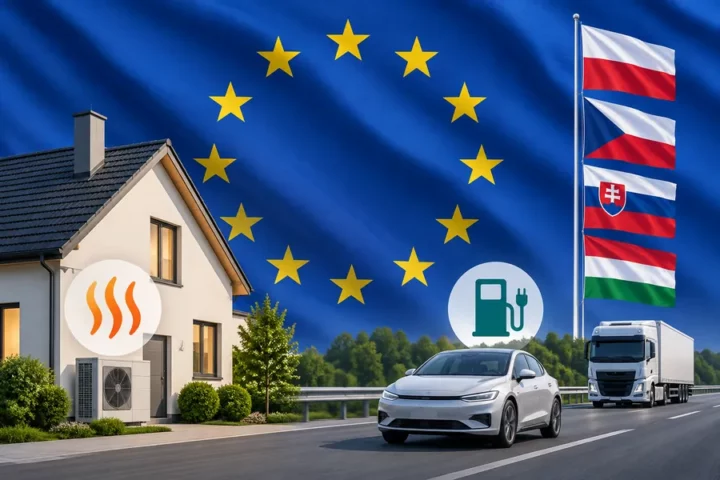
Poland, Czechia, Slovakia and Hungary are calling for the first auction of emissions allowances under ETS2 — the EU system covering emissions from fuels used in buildings and road transport — to be postponed. According to Euronews, the four countries’ leaders have written to European Commission President Ursula von der Leyen. Their request is a political proposal, not an agreed change to the timetable.
The letter is dated 23 November 2026. Euronews, which reported on it the following day, says it has seen the document. The members of the Visegrad Group, known as the V4, want the system reassessed and the first auction put on hold until its future is clarified and legal certainty is secured.
The auction and the launch are separate milestones
Under the timetable described by Euronews, the first auction is scheduled for January 2027, while the launch of ETS2 itself has already been postponed until 2028. These are two separate milestones: the V4’s latest request concerns the auction preceding the system’s launch.
The dispute matters to households and businesses because ETS2 covers fuels used to heat buildings and power road transport. The letter’s authors warn of additional costs which, they argue, could weaken consumption, employment and investment. These are forecasts put forward by the four countries, however, rather than established effects of the system.
According to Euronews, the V4 leaders also question whether the Social Climate Fund will provide households and microbusinesses with sufficient support at the right time.
V4 seeks a fresh assessment as other countries defend the timetable
The four countries are calling for an updated impact assessment of ETS2. They argue that the European Commission’s 2021 analysis no longer reflects current conditions. A new assessment would take account of energy prices, inflation forecasts and different scenarios for emissions allowance prices.
That position is not shared across the EU. Euronews reports that eight other member states also called on 23 November for the ETS2 timetable to be maintained. They point to the system’s role in supporting electrification and reducing dependence on imported fossil fuels.
The V4 letter therefore highlights a dispute not only over timing, but also over the system’s economic consequences. The request from Poland and its partners does not, in itself, change the ETS2 rules or timetable.