Contents
- What does priority to the right mean in Poland?
- At an unmarked UK junction, nobody has automatic priority
- Look at the road surface: Give Way is more than an upright sign
- Why do drivers look right at a roundabout?
- How a misunderstanding can lead to a collision
- What does the law say after a collision?
- Does the same principle apply in Northern Ireland?
- Sources and information date
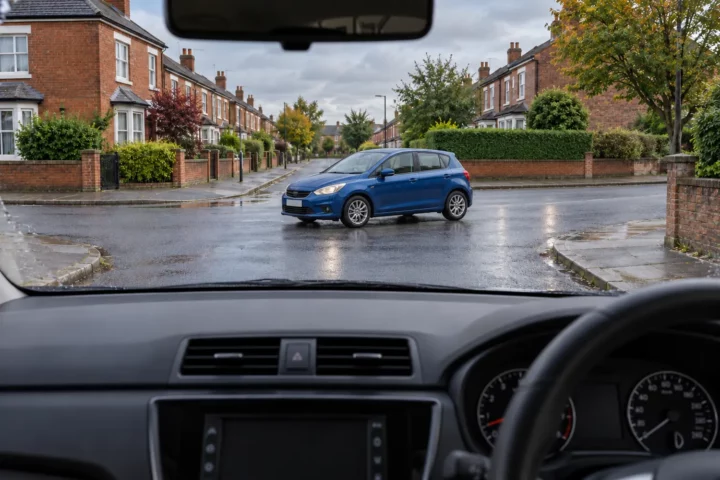
A quiet street between terraced houses, a few parked cars and a junction without traffic lights. Another car approaches from your right. If you learnt to drive in Poland, you may instinctively expect to give way. When you are the driver approaching from the other person’s right, you might expect them to stop for you. On a British road, that expectation can be misplaced.
The UK does not apply Poland’s general priority-to-the-right rule at unmarked junctions. Nor does driving on the left create an equivalent rule giving automatic priority to traffic from the left. Understanding the difference matters before you meet another driver and both of you hesitate — or both decide to go.
What does priority to the right mean in Poland?
At a Polish junction where the roads have equal priority, a driver generally gives way to a vehicle approaching from the right. This follows from Article 25 of Poland’s Road Traffic Act. The provision also requires particular care and, when turning left, giving way to oncoming traffic going straight ahead or turning right. Rail vehicles are treated separately.
It is not a rule that every vehicle approaching from the right has priority on every Polish road. Instructions from someone directing traffic, traffic signals and road signs can require a different response; Article 5 establishes their precedence over the general rules. The direction another vehicle comes from cannot be considered without checking the actual situation.
Nevertheless, it is understandable that someone familiar with Polish equal-priority junctions would look for the same rule in the UK. Moving to the other side of the road, or using a right-hand-drive car, does not automatically change habits learnt during driving lessons.
At an unmarked UK junction, nobody has automatic priority
The Highway Code, the official collection of road rules and guidance, warns in Rule 146 about unmarked junctions on side roads and country lanes where nobody has priority. That is the starting point for assessing the situation, rather than permission to proceed whenever you choose.
You cannot expect someone to give way simply because you approach from their right. Going straight ahead, or thinking that your road looks more important, does not by itself guarantee priority either. With no priority allocated to one side, you need to pay close attention to the other driver’s movements.
Imagine two drivers approaching from roads that cross, both intending to go straight ahead. With no signs or markings assigning priority, Poland’s familiar answer — let the person on the right go first — does not determine who proceeds. Both should slow down, stop if necessary and move only when they can cross safely.
There is no replacement rule of ‘first come, first served’. Waiting courteously may help the other driver, but it cannot replace their own observations. If both cars start moving, stop the manoeuvre when safety requires it. Accelerating to demonstrate an assumed right to proceed only makes the situation harder to resolve.
Look at the road surface: Give Way is more than an upright sign
A Give Way instruction can be conveyed by road markings. The official Highway Code road-marking guide shows a double broken line across an approach as an instruction to give way to traffic on the major road. The absence of an upright sign beside it does not allow you to ignore the line.
Rules 171 and 172 distinguish a STOP junction from a Give Way junction. At a STOP sign and solid line, you must stop. When emerging across broken Give Way lines, you must give way to traffic on the main road. This is not a question of choosing which side deserves priority: the requirement concerns traffic on that road.
Before treating a junction as unmarked, ask whether you have checked the road surface as well as the roadside. Rain, shadows, parked vehicles or worn paint can make the layout harder to read. If you cannot establish how the junction is controlled, use that uncertainty as a reason to slow down, rather than as a justification for carrying on.
Why do drivers look right at a roundabout?
Roundabouts have a separate rule. Under Rule 185, you give priority to traffic approaching from your right unless signs, road markings or traffic lights direct otherwise. That instruction does not apply to every ordinary unmarked junction. Looking in the same direction does not mean the legal basis for priority is the same.
This explains the practical difference between Poland and the UK: their rules provide different answers when signs or markings have not established priority at a junction. Poland has a general rule based on traffic approaching from the right; the British Highway Code identifies unmarked junctions where nobody has priority. Left-hand traffic does not justify inventing a priority-to-the-left rule. This is a comparison of the rules in force, rather than an account of their historical origins.
How a misunderstanding can lead to a collision
Consider an illustrative situation. You approach from the other driver’s right and assume that they will wait. They see nothing assigning priority to you and begin to move as well. If both of you act on different assumptions, your paths may cross. This is an example of how a misunderstanding could develop, not an account of a particular crash.
Rule 170 advises looking all around before emerging and waiting for a gap large enough to complete the manoeuvre safely. Rule 176 says that when traffic lights are not working, drivers should treat the situation as an unmarked junction and proceed with great care. Failed lights do not activate Poland’s priority-to-the-right rule.
Without suitable evidence, it would be wrong to claim that Polish drivers frequently cause this particular type of collision. The useful lesson is more specific: do not expect another road user to follow the rules of a different country. Reviewing familiar habits is worthwhile, just as it is when checking the rules in our guide to using a mobile phone while driving in the UK.
What does the law say after a collision?
Not every Highway Code rule has the same legal status. Its official introduction explains that MUST and MUST NOT identify legal requirements. Rules worded with SHOULD provide guidance, but may still be used as evidence in court proceedings to establish liability. Ignoring guidance is therefore not something that can always be dismissed as legally irrelevant.
Rule 144 prohibits dangerous driving and driving without due care and attention, referring to the Road Traffic Act 1988. After a collision, saying ‘I was on the right’ cannot settle the matter. The incident needs to be assessed against the rules that apply locally. Equally, the absence of automatic priority does not establish a predetermined division of responsibility between the drivers.
If a collision causes injury or damage covered by Rule 286, you must stop and provide the required details, including your name and address, the vehicle registration and the vehicle owner’s details. If you do not provide your name and address at the scene, report the collision to the police as soon as reasonably practicable and within 24 hours. Where another person is injured, Rule 287 sets out additional requirements concerning evidence of insurance.
Call 999 if there are injuries or immediate danger. If it is safe, keep photographs of the markings, damage and vehicle positions, along with witness details. GOV.UK also says to notify your insurer, even if you do not intend to make a claim. Record the facts so that they can be assessed against the evidence, rather than trying to settle fault through an argument at the junction.
Does the same principle apply in Northern Ireland?
The Highway Code on GOV.UK applies to England, Scotland and Wales. Northern Ireland has its own Code and legal framework. On this particular point, the guidance is the same: Rule 146 on nidirect also refers to unmarked junctions where nobody has priority. That does not mean every other road rule or penalty is identical throughout the UK.
At a British junction, the most useful habit is to read the signs and markings, check every direction and avoid expecting priority solely because of where you are. When the situation is unclear, a few seconds spent observing it are worth more than trying to proceed using a remembered formula.
Sources and information date
The rules were checked on 13 October 2026. The collision example illustrates a possible misunderstanding; it is not a documented incident. This article explains general principles. Assessing a particular case requires its circumstances and evidence.
- GOV.UK: Highway Code — Rules 144 and 146
- GOV.UK: junctions and roundabouts — Rules 170–176 and 185
- GOV.UK: road markings
- GOV.UK: the legal status of Highway Code rules
- Polish official legislation: Road Traffic Act — Articles 5 and 25
- nidirect: Northern Ireland Highway Code — Rule 146
- GOV.UK: incidents and documentation — Rules 283, 286 and 287
- GOV.UK: insurance and obligations after an accident