People from ethnic minorities accounted for 24% of those selected for checks using a particular South Wales Police facial recognition system in 2025, despite making up 7% of the population in the force’s area. The figures, revealed by the Guardian, show a disparity in who officers chose to scan. The force acknowledged concerns about disproportionality and pledged to continue reviewing its practices.
Privacy campaign group Big Brother Watch obtained the statistics through a freedom of information request and shared them with the newspaper. In its report published on 15 November 2026, the Guardian described people from ethnic minorities as about four times more likely than white people to be selected for these checks. The same report said ethnic minorities accounted for 11% of people arrested in the force’s area.
Officers take a photograph — this is not live crowd scanning
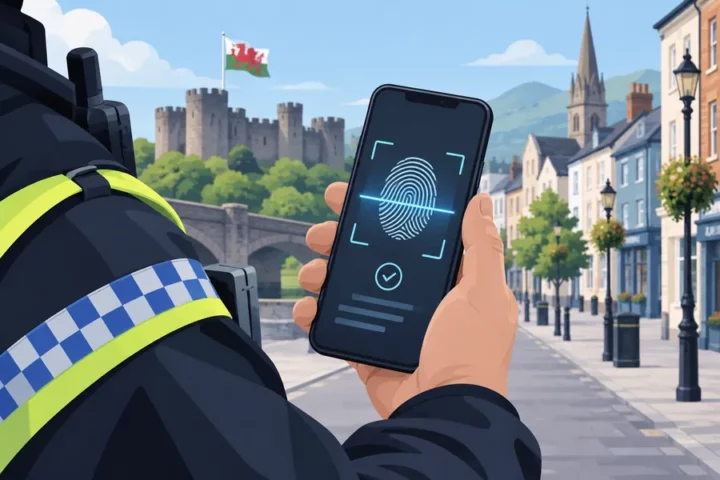
The figures cover officer-initiated facial recognition, known as OIFR. An officer takes a photograph using a smartphone, and the Neoface system compares it with images held in police databases. These are therefore not statistics on live cameras scanning passing crowds, nor do they cover every police use of facial recognition.
During 2025, South Wales Police officers initiated scans involving 257 adults and 14 children. More than half of the checks concerned suspected offences, people being unlawfully at large or breaches of bail conditions.
Among cases in which the system returned a match, 48% resulted in an arrest, while about a third led to no further action. Those outcomes are not conviction statistics and do not establish that every match was correct.
Equality concerns as police pledge further review
Big Brother Watch and Race Equality First said the figures raised concerns about unequal treatment of ethnic minorities. The central issue here is whom officers select for a check. The disparity alone does not prove discriminatory intent by officers or show that the algorithm performs differently across ethnic groups.
In a response quoted by the Guardian, South Wales Police acknowledged that the figures raised concerns about disproportionality. It also stressed the limited scale of OIFR use, consideration of individual circumstances and oversight of the technology. The force pledged to continue reviewing its practices with independent advisory groups and external scrutiny panels. That is a commitment to further scrutiny, rather than confirmation that changes have already been introduced.
The findings concern one force, South Wales Police. They cannot establish the extent of similar disparities across Wales or the UK as a whole.