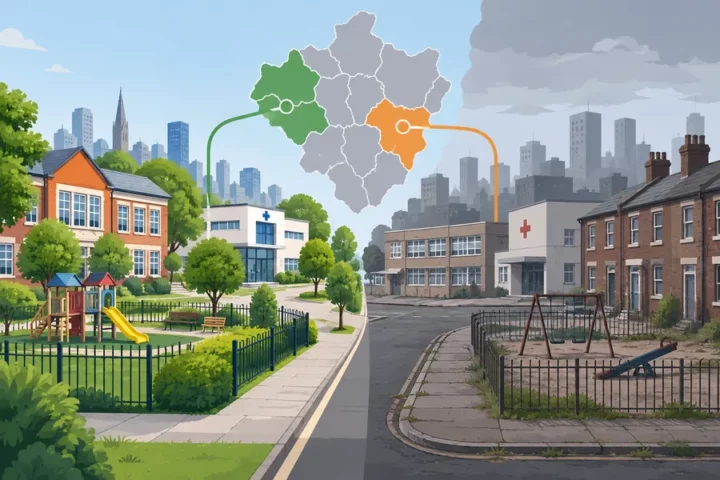
Where a child lives in England is linked to stark differences in their experience of growing up, from school results to how safe they feel. According to the BBC, England’s Children’s Commissioner, Dame Rachel de Souza, warns in her “Childhood Lottery” report that poverty alone cannot explain the scale of these inequalities. She is calling for minimum standards for children’s services and a dedicated fund to improve their quality urgently.
The analysis draws on around 100 indicators covering areas including health, social care, education, safety and opportunities to play. De Souza described the situation as an emergency requiring urgent action. That is the commissioner’s assessment, rather than a formal declaration of a state of emergency.
Wide gaps in school results and feelings of safety
One example highlighted by the BBC concerns GCSEs, the exams usually taken in England at the age of 16, towards the end of compulsory schooling. In Richmond upon Thames, 70% of children achieved good results in English and maths, compared with 31% in Knowsley. There were also marked differences in children’s everyday surroundings: 6.7% of children in Bedford said they felt unsafe in their area, compared with 24.9% in Croydon.
The indicators describe different aspects of childhood and should not be treated as a single snapshot taken at the same time, or as figures relating exclusively to 2026. They nevertheless illustrate how widely the conditions in which children grow up can vary across England.
Middlesbrough, Hounslow, Bradford, Nottingham, Halton, Peterborough, Leicester, Liverpool, Sunderland and Medway were among the places the report classified as the most difficult to grow up in. That classification reflects the indicators used in the analysis; it is not a judgement on every neighbourhood or the experience of every child living there.
Poverty does not explain everything
A significant finding is that areas with greater deprivation — poorer social and economic conditions — do not always perform worse than more affluent places. The BBC highlights the London borough of Haringey as an example of an area achieving good outcomes despite substantial deprivation. Cambridge, by contrast, was rated lower despite relatively low levels of deprivation.
The commissioner wants minimum standards to safeguard children’s access to services of an adequate quality. She also proposes a dedicated intervention fund and greater responsibility for children’s issues among larger councils and strategic authorities. One recommendation is a deputy mayor with responsibility for children. These are proposals in the report, not changes that have already been adopted.
In its response quoted by the BBC, the Department for Education, the government department responsible for education in England, pointed to measures covering childcare, school standards, local support, and training and employment opportunities for young people. This sets out the government’s position on the report; citing those measures does not in itself mean the inequalities identified have been resolved.