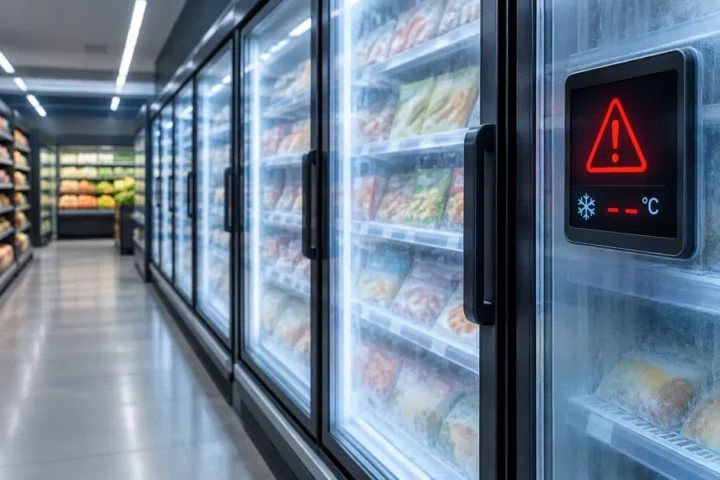
Disruption to refrigeration systems has forced some European supermarkets to throw away food. The BBC reports a wave of cyberattacks on 2 November, with the European Commission coordinating the response. Problems were reported in ten countries, although a cyberattack has not been confirmed as the cause in every case.
According to the BBC, reports came from Belgium, Estonia, Finland, Ireland, Italy, Luxembourg, the Netherlands, Portugal, Germany and Sweden. Temperatures in some refrigeration units reportedly rose as high as 50°C. Belgium’s federal prosecutor has opened an investigation after dozens of shops reported cooling failures.
Some businesses have confirmed that their incidents were cyber-related. Musgrave Group, cited by the BBC, said 13 SuperValu shops in Ireland were affected. Portugal’s Mosqueteiros group linked disruption at seven Intermarché shops to a cyberattack that probably targeted an external provider of refrigeration management services.
Not every report amounts to a confirmed attack, however. Swedish retailer ICA confirmed refrigeration problems but not a cyber-related cause, while Finland’s Kesko was investigating abnormal temperatures. Neither a common mechanism behind all the incidents nor those responsible had been established.
EU response and confirmed attacks in Poland
RMF24 reports that two coordination meetings took place on 3 November. One involved the European Union Agency for Cybersecurity (ENISA), Europol and European Commission services. The other brought together member state representatives through CYCLONe, the European cooperation network for responding to large-scale cybersecurity incidents.
In Poland, the confirmed attacks concern two refrigeration units. According to RMF24, the national cybersecurity response team CERT Polska confirmed the attacks to the newsroom. This does not establish wider disruption across Polish retail.
The European Commission has not identified those responsible. According to RMF24, determining responsibility is a matter for the national authorities conducting investigations.
UK cybersecurity centre urges software updates
The BBC reports that the UK’s National Cyber Security Centre (NCSC) has urged retailers to update the software controlling refrigeration temperatures. NCSC chief Richard Horne referred to a couple of instances in which vulnerable technology had been exploited in the UK, while noting that the full extent of the impact was unknown.
His comments do not confirm attacks on British supermarkets or establish that the same equipment or vulnerability was involved across all countries. The picture currently includes both confirmed cyberattacks and refrigeration failures whose causes remain under investigation.