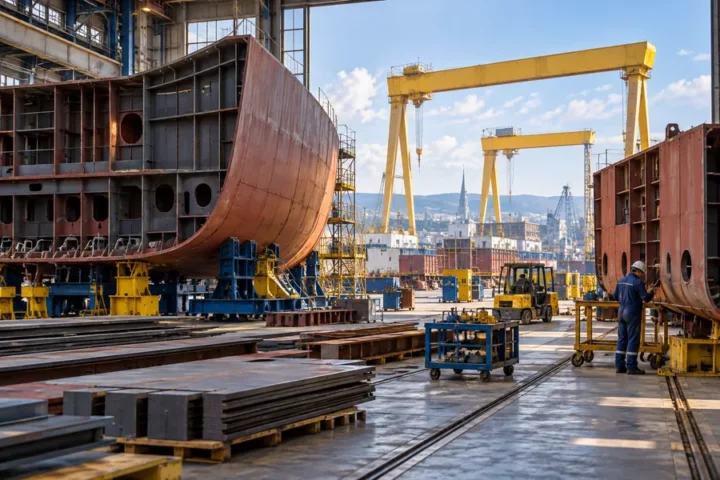
The Resurgent fabrication hall has opened at Belfast’s Harland & Wolff shipyard, where it will support the construction of three supply ships for the British fleet. According to the government, the investment will support more than 900 skilled jobs and apprenticeships. That does not mean 900 new jobs have been created or that this number of vacancies has been announced.
Luke Pollard, Minister for Defence Readiness and Industry, officially opened the hall on 2 November 2026. The facility at the Navantia UK-owned shipyard is a central part of a wider modernisation programme. The company is investing £157 million across four UK shipyards, with around £100 million allocated to Belfast. The Belfast figure covers investment across the shipyard, rather than the cost of the hall alone.
More production space and new equipment
The expanded hall provides an additional 5,000 square metres of production space. It is equipped with new overhead cranes, robotic plasma-cutting technology and a mechanised panel line. Modernisation of the yard also includes refurbishment of Samson and Goliath, the distinctive yellow cranes long associated with Belfast’s skyline.
For the local labour market, the investment matters not only because of the production facilities but also because of opportunities to train in shipbuilding trades. The government’s figure of more than 900 combines supported jobs and apprenticeships, so it should not be read as an announcement of a single recruitment drive.
Three ships to supply the fleet at sea
The hall will be used to build RFA Resurgent, Reliant and Resourceful under the Fleet Solid Support (FSS) programme. The ships are destined for the Royal Fleet Auxiliary, the support service that supplies Royal Navy task groups at sea.
Navantia UK is the prime contractor for the programme, covering the manufacture and final assembly of all three ships. The Ministry of Defence is funding it with £1.6 billion. According to the government statement, work is on schedule and within budget. All three ships are planned to enter service in the early 2030s; that remains a planned timetable.