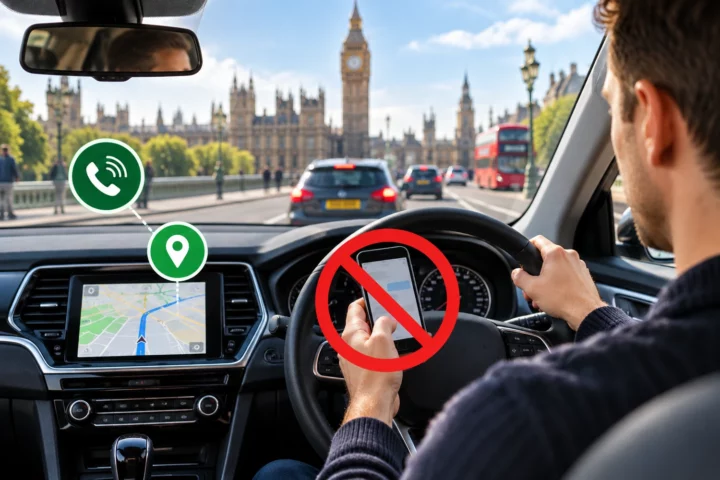
The rules around using a mobile phone while driving in the UK may seem straightforward, but many drivers are still unsure about what is and is not allowed.
The simplest rule is:
you must not hold and use a mobile phone while driving.
And this rule is not limited to making phone calls. It applies much more broadly to using a phone or similar interactive device while driving.
It is not just about making calls
The Highway Code makes it clear that you must not use a hand-held mobile phone or similar interactive device, such as a tablet, for any purpose while driving.
This also applies when you are supervising a learner driver.
In practice, this means you must not pick up your phone to:
- answer a call,
- make a call,
- read or send a message,
- check notifications,
- choose music,
- unlock the screen,
- take a photo or record a video,
- check a route in a navigation app,
- scroll through the screen,
- quickly change a setting.
If the device is in your hand, you are at serious risk of breaking the law.
What if you are stopped in traffic or at a red light?
This is one of the most common misunderstandings.
The ban does not apply only when the vehicle is moving.
You must not pick up and use a hand-held phone while you are stationary in traffic either.
This includes situations such as:
- waiting at traffic lights,
- sitting in a traffic jam,
- being temporarily stopped in a queue.
So saying “I was only stopped at the lights” does not make hand-held phone use legal.
Is hands-free use legal?
The law mainly targets hand-held devices, but that does not mean hands-free use is always safe.
The Highway Code warns that hands-free equipment can still distract you from the road.
You may use equipment such as:
- Bluetooth,
- a hands-free system,
- voice control,
- a phone mounted in a holder,
- an in-car communication system,
but you must remain in proper control of the vehicle at all times.
If the police believe you are distracted and not driving with proper care and attention, you can still face consequences even if the phone was not in your hand.
What about sat nav and in-car screens?
Using a sat nav or navigation app is not automatically illegal.
However, you must not allow the screen or navigation system to distract you from driving.
The Highway Code specifically warns about distractions caused by:
- satellite navigation systems,
- multimedia screens,
- congestion warning systems,
- computers,
- other in-vehicle technology.
The safest approach is to set your destination before starting your journey.
While driving, avoid:
- typing a new address,
- changing complicated settings,
- scrolling through menus,
- looking at the screen for too long.
If you need to make changes that require your attention, find a safe place to stop first.
Are there any exceptions?
There are a few specific exceptions.
1. Calling 999 or 112 in an emergency
You may use a hand-held phone to call 999 or 112 in a genuine emergency if it is unsafe or impractical to stop.
This is intended for real emergencies, not ordinary phone calls.
2. Contactless payments
There is also an exception for certain contactless payments.
You may use a hand-held device to make a contactless payment when:
- the vehicle is stationary, and
- the goods or services are received at the same time as, or after, the payment.
This can apply, for example, at some drive-through services or payment points.
3. Remote parking
You may also use a legal hand-held remote control app or device for remote parking.
You must still make sure that using it does not put other people in danger.
What is the penalty?
Using a hand-held mobile phone while driving can result in:
- 6 penalty points, and
- a £200 fixed penalty notice.
For some drivers, those six points can have much more serious consequences.
In particular, new drivers who have held their licence for less than two years risk having their licence revoked if they reach six penalty points.
Why are the rules so strict?
The reason is simple: mobile phones are a major distraction.
Using a phone can reduce your awareness of what is happening around you and can affect:
- reaction time,
- lane positioning,
- decision-making,
- awareness of other road users,
- overall control of the vehicle.
This is why the rules are no longer focused only on making calls. The ban covers a much wider range of hand-held phone use.
Common mistakes
Many drivers get into trouble because they think:
- “I was only checking the time.”
- “I only answered for a second.”
- “I was stopped at the lights.”
- “I only looked at the map.”
- “The car was not moving.”
- “I only held the phone briefly.”
But even a short distraction can create a dangerous situation.
How can you use your phone more safely?
The safest rule is simple:
do not pick up your phone while driving.
Before setting off, you can:
- set your navigation,
- choose your music or podcast,
- enable Do Not Disturb while driving,
- place the phone in a secure holder,
- activate voicemail,
- put the phone somewhere out of reach.
If you really need to use it, find a safe place to stop first.
Summary
The UK rules on using a mobile phone while driving are strict.
The most important points are:
- you must not hold and use a mobile phone while driving,
- the ban also applies when you are stopped in traffic or at traffic lights,
- hands-free use is permitted only if you remain in full control of the vehicle,
- sat nav and in-car screens must not distract you,
- the main exceptions cover emergency calls, certain contactless payments and remote parking,
- the standard penalty is 6 points and a £200 fine.
The safest rule to remember is simple:
if you are driving, do not use your phone in your hand.