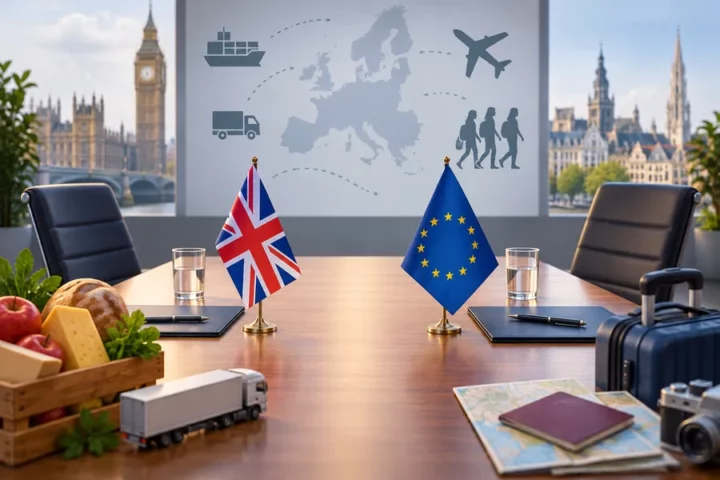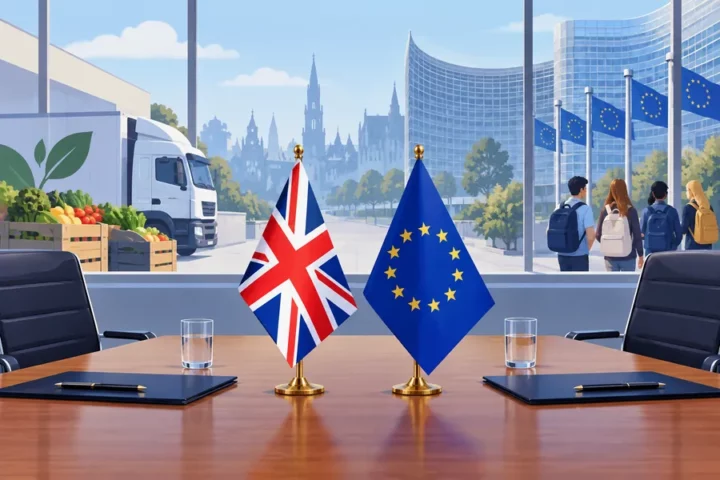
A UK–EU agreement has been reached, a British government spokesperson told the Associated Press, according to DW. Separately, DW, citing DPA and EU diplomats and officials, reports that implementation of the agreements would depend on reaching a deal to reduce tuition fees for EU students in the UK. The summit is taking place in Brussels on 20 November; according to DW and the BBC, Prime Minister Andy Burnham is attending. The spokesperson’s statement does not mean that the proposed measures are already rules in force.
DW quotes a British government spokesperson telling the Associated Press that an agreement has been reached, with details to follow in a joint statement. Its reporting also identifies matters still requiring agreement, particularly tuition fees for EU students at British universities. A political declaration therefore does not mean that every part of the package is ready to be implemented.
Fewer food checks, but paperwork would remain
An agri-food agreement is one of the central areas of negotiation. The BBC describes the expected arrangement as involving the whole of the UK aligning with EU rules for the products covered by the deal. This would be intended to ease trade and reduce some of the barriers introduced after Brexit.
The arrangement could be particularly significant for food moving from Great Britain to Northern Ireland. According to BBC analysis, it could substantially reduce regulatory checks and cut paperwork. It would not, however, remove customs obligations. For businesses, that would mean simpler procedures in some areas rather than a return to trade without documentation.
Youth mobility and tuition fees
Another key issue is a mobility scheme which, according to DW, would make it easier for young people to travel between the UK and the EU for work and study. It should not yet be regarded as an available route. DW’s reporting does not set out detailed eligibility requirements, age limits or a launch date.
DW, citing the German news agency DPA and EU diplomats and officials, reports that implementation of the agreements would depend on reaching a deal to reduce tuition fees for EU students in the UK. According to that account, the two sides aim to reach an agreement on fees within the next six months. This is a negotiating target, not an approved fee reduction or a date when new rates would take effect.
DW also lists linking the UK and EU emissions trading systems among the summit’s main topics. The electricity market remains a separate issue: according to the BBC’s reporting, an agreement in that area is not expected to form part of the current package, and negotiations are continuing.
For people considering studying or working across the Channel, and for businesses trading between the UK and the EU, the final terms and implementation dates will be crucial. The summit itself, and a statement that agreement has been reached, do not yet change travel rules, tuition fees or trading procedures.