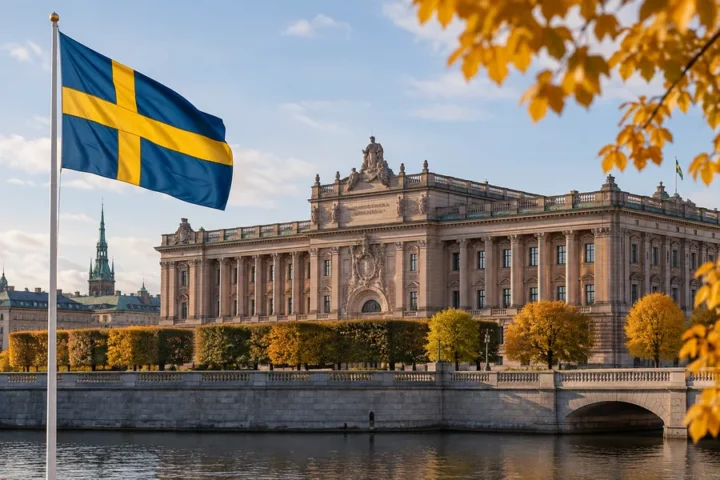
Magdalena Andersson has again ended talks on forming a Swedish government without an agreement. According to Euronews, the Social Democrat leader announced on 13 October that, despite progress in negotiations with the three other parties in her bloc, there were currently no conditions for forming a government that parliament would allow to take office. Her candidacy for prime minister is nevertheless due to go to a vote on Thursday, 15 October.
Parliament’s Speaker, Andreas Norlén, said the vote would proceed despite the failure of the talks. Euronews reports that he explained this had been the intended conclusion of Andersson’s mandate from the outset, regardless of the negotiations’ outcome. The lack of an agreement therefore does not yet mean that MPs have rejected her candidacy.
A majority of seats, but no agreement
Following the election on 13 September, the centre-left bloc holds 176 seats, compared with 173 for the right-wing bloc of outgoing prime minister Ulf Kristersson. That narrow advantage has not, however, produced a common position on the composition of the next government.
The central dispute concerns whether the Left Party should join the cabinet. The Centre Party opposes its inclusion, while the Left Party has made its support for a left-wing government conditional on having a place in it. Those opposing demands have made it difficult for Andersson to find an arrangement acceptable to her partners.
This is another unsuccessful round of negotiations for the Social Democrat leader. She received her first mandate to hold talks on 18 September and ended it without success on 28 September. The latest setback prolongs the wait for a new government, while Kristersson continues to lead a caretaker administration.
What will the vote decide?
As Euronews explains, Sweden’s procedure does not require a candidate for prime minister to win the votes of a majority of MPs. A candidate can take office provided that a majority of parliament does not vote against them. The absence of a coalition agreement and the outcome of a vote on a prospective prime minister are therefore separate matters.
Norlén said Andersson was unlikely to secure parliament’s approval, but that is a prediction, not the result of the scheduled vote. He also described Kristersson as the natural candidate for the next mandate to hold talks, without committing to giving him that role.
According to Euronews, four unsuccessful parliamentary votes on proposed candidates for prime minister would trigger an early election. That limit applies to votes, not rounds of negotiations: Andersson’s two attempts to reach an agreement should not be counted as two rejected candidacies.