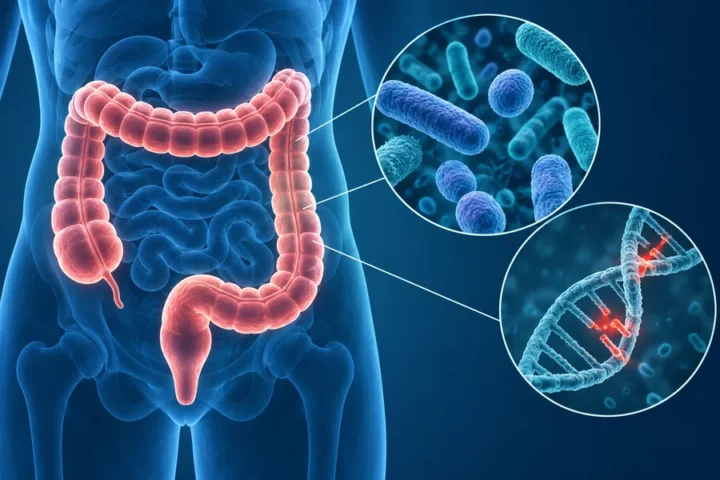
A toxin produced by some E. coli bacteria could play a role in bowel cancer developing before the age of 50, scientists have told MPs. According to the Guardian, researchers are examining the possible importance of exposure to colibactin in early childhood. The hypothesis does not, however, establish what is causing the rise in cases among younger adults.
Colibactin is a toxin produced by certain strains of E. coli found in the gut. The hypothesis therefore does not concern all E. coli bacteria. Scientists discussed it before the House of Commons science and technology committee.
A signature in tumour DNA, not proof of a cause
In its report published on 18 November 2026, the Guardian cites earlier research in which characteristic mutations caused by colibactin were three times as common in tumours from people under 40 as in those from patients over 70. This compares two specific age groups, rather than all patients below and above 50. It does not mean that the risk of developing bowel cancer was three times higher.
These DNA changes offer researchers a clue, but their greater frequency alone does not prove that colibactin is responsible for rising bowel cancer cases among younger people. The report concerns expert testimony and interpretations of earlier findings, rather than the announcement of a new study.
Professor Helen Coleman of Queen’s University Belfast emphasised that the toxin’s potential role remains under investigation. According to the newspaper’s account, relevant exposure to colibactin may have occurred very early in life — long before a cancer diagnosis.
Known risk factors do not explain everything
Dr Karl Smith-Byrne of the University of Oxford told MPs that established risk factors, including obesity, smoking and alcohol, may explain only around half of diagnosed bowel cancer cases. The Guardian reports that he found it unconvincing to attribute the entire increase among younger people to these factors alone. That does not, however, mean the remaining cases can be attributed to colibactin.
The difference in risk between age groups remains important: despite the attention on younger adults, bowel cancer is still much more common in people over 50. Research into colibactin may help explain some of the unknowns, but it does not yet provide a definitive answer to why cases before 50 are increasing.