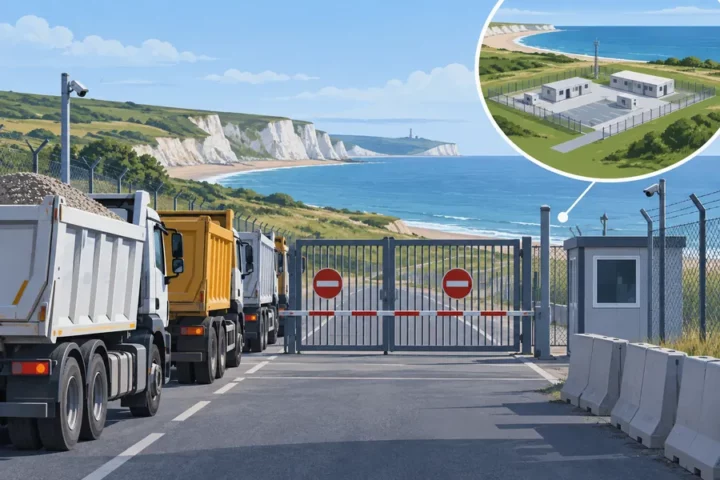
Israel is preventing construction from starting on a base for international stabilisation forces in Gaza, The Guardian reported on 14 October. According to an anonymous source with direct knowledge of the matter, contractors and lorries are not being allowed to cross the border. The project is part of the work of the Board of Peace, an organisation led by Donald Trump.
The newspaper reports that in early August 2026, the Board of Peace commissioned Louisiana-based Arkel International to build a facility for 150 soldiers. The planned fortified compound would measure approximately 100 by 100 metres and occupy land previously used by the Gaza Humanitarian Foundation.
The report therefore concerns a construction project that cannot get under way, rather than an operational base. The claim that access is being blocked comes from The Guardian’s source; the newspaper provides neither official confirmation nor an explanation from Israel. According to the report, a Board of Peace spokesperson, the Israeli military and the Israeli government declined to comment.
Base intended to pave the way for further work
The project’s significance extends beyond accommodation for troops. The newspaper’s source said that without the facility and the presence of stabilisation forces, subsequent work could not begin, including bringing in construction equipment and developing infrastructure. That is the assessment of a source describing the project, rather than an independently established consequence for Gaza’s entire reconstruction programme.
According to the article, on 23 September 2026 the Board of Peace presented a six-month plan worth $2.45 billion. It was intended to form the first stage of reconstruction, with the cost over ten years estimated at $71 billion. These figures describe the proposed plan and estimated costs, not money already spent or completed developments.
It remains unclear when the restrictions described by the newspaper might be lifted. The report also does not establish precisely when they began. At this stage, The Guardian’s main new finding is that, despite the construction contract being awarded, contractors — according to the newspaper’s source — still cannot enter Gaza and begin work.