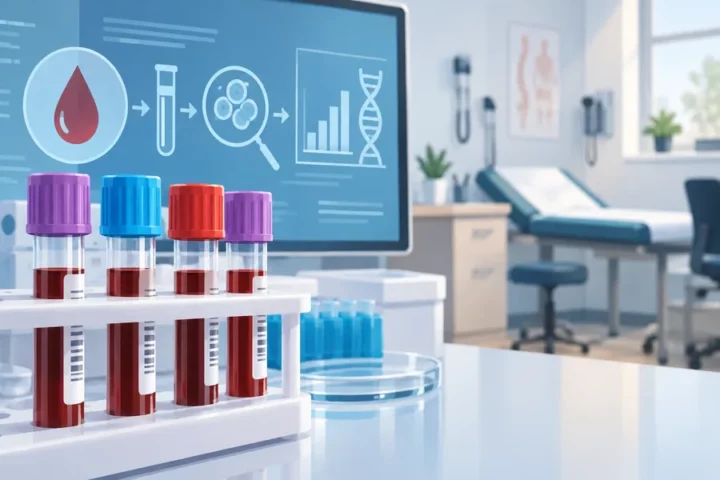
More than 20,000 patients in England are expected to take part in a trial examining whether blood tests can help GPs refer people with suspicious symptoms for cancer investigations sooner. The STRIDE-RCT programme, announced on 4 November 2026, will involve at least 200 NHS GP practices. It is an assessment of new tests, not an announcement of their routine availability or confirmation that they work.
According to the government announcement, participation will be offered to patients aged 45 and over who attend participating practices with abdominal symptoms, such as persistent bloating or discomfort. It will therefore not be a general screening programme for people without symptoms.
One sample, signs of several cancers
Participants will have one or two tubes of blood taken at their GP practice alongside routine tests. The tests will look for signs of several cancers in a sample and indicate where those signs may have originated. Most were developed at the University of Birmingham and use a range of technologies, including blood protein analysis and artificial intelligence.
The trial covers cancers of the large and small bowel, stomach, oesophagus, pancreas, liver, bile ducts and gallbladder, as well as ovarian, endometrial — affecting the lining of the womb — kidney, bladder and prostate cancers. Researchers will assess whether the results, used alongside the judgement of a general practitioner, or GP, help identify patients who need further investigations sooner.
A result is not a diagnosis
A positive result is intended to support a decision to make an urgent referral for further investigations, but does not itself constitute a cancer diagnosis. A negative result, as BBC News notes, does not guarantee that cancer can be ruled out. These limitations matter: the programme has yet to establish how much value the tests add to a GP’s assessment.
For patients, the announcement also does not mean that the tests can be obtained at any NHS practice. The trial concerns selected practices in England and a defined group of people with symptoms. The effectiveness of this approach will be assessed before wider use is considered.
The programme is set to receive up to £8.49 million in government funding through the Office for Life Sciences, which supports the life sciences sector, and the National Institute for Health and Care Research (NIHR), which funds health and care research. This is the upper limit of the announced support, not money already spent. Practices in inner-city, rural, coastal and socioeconomically deprived communities are expected to take part. Earlier cancer diagnosis and better-targeted referrals remain the programme’s aims, rather than results it has already demonstrated.