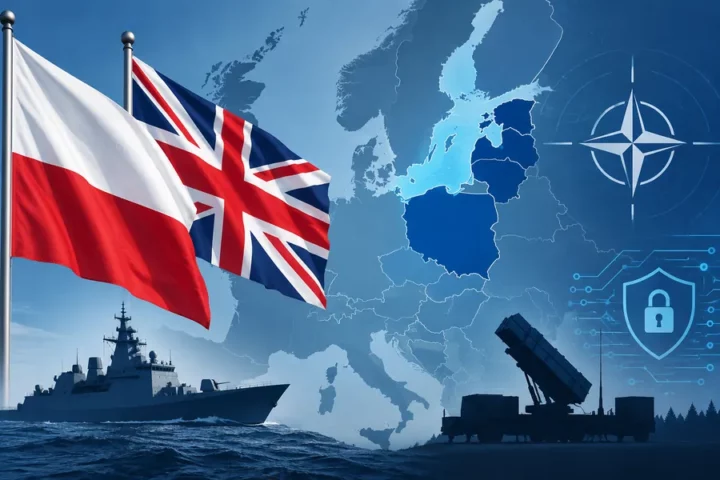
Poland and the UK have announced a new defence cooperation plan covering air defence, drone technology, Baltic security and ammunition production. The Warsaw Defence Plan aims to strengthen security and deterrence on Europe’s eastern flank, the UK Ministry of Defence said on 27 October 2026.
The announcement accompanies a meeting in Warsaw between UK Defence Secretary Wes Streeting and Polish Defence Minister Władysław Kosiniak-Kamysz. The ministry describes the plan as the first stage of defence cooperation under a new UK–Poland security and defence partnership treaty. Its statement does not, however, establish the treaty’s ratification status or when it enters into force.
Air defence, drones and joint production
One of the main areas of planned cooperation is the development and production of next-generation air defence missiles. The two countries also intend to develop drone and counter-drone technologies together. The plan includes closer cooperation on cyber security and improving the resilience of both military and civilian infrastructure.
The defence industry is expected to play a significant role. According to the ministry, BAE Systems and Polska Grupa Zbrojeniowa, the Polish defence group, are to increase production capacity for large-calibre ammunition. Further coordination of defence procurement is also planned, alongside cooperation on education, training and workforce mobility. This gives the agreement relevance not only to the armed forces but also to manufacturers and specialists in both countries.
These are commitments to future joint work, rather than confirmation that additional production capacity has been achieved or new weapons delivered. The statement does not give an overall budget, detailed delivery timetable or figures for the planned increase in ammunition production.
Closer cooperation in the Baltic
The maritime element of the plan includes sharing experience between the UK’s Type 31 frigate programme and Poland’s Miecznik programme. Both are based on a common design, providing a basis for closer cooperation. The ministry also announced plans to increase defensive maritime activity in the Baltic through exercises and regional coordination.
The statement also sets out plans for coalition of the willing exercises in Poland in November 2026, involving thousands of participants. According to the ministry, these are intended to prepare multinational forces to support military training and Ukraine’s post-war reconstruction. The announcement of the exercises does not mean that deployment of such forces to Ukraine has begun.
The Warsaw Defence Plan therefore sets a broad agenda for Polish–British cooperation, from joint weapons development and infrastructure protection to maritime activity. Its stated aim is stronger deterrence on Europe’s eastern flank; tangible results will depend on the delivery of the projects announced.