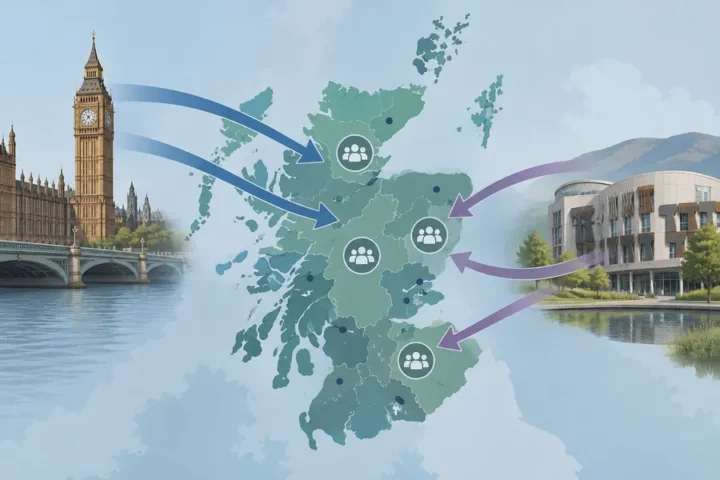
Prime Minister Andy Burnham is expected to invite the Scottish government to work with him on transferring more decision-making powers to Scotland’s regions and cities, according to the Guardian. He is due to outline the proposal in a speech in Lanarkshire on 16 October. The aim would be to move some powers from both Westminster, the UK level of government, and Holyrood, the Scottish Parliament, closer to local communities.
The newspaper reports that the invitation will be addressed to Scotland’s First Minister, John Swinney. An advance extract of the speech quoted by the Guardian presents the initiative as an offer of cooperation with the Scottish government. It is not, however, an agreed reform or a change to the existing division of powers.
The central question is what the proposed changes would cover. The announcement does not identify specific powers that would pass to regions and cities, or set out funding, a timetable or a legal mechanism for transferring them. Nor is there confirmation that the Scottish government has accepted the offer. It is therefore not yet possible to say which decisions affecting residents’ daily lives might eventually be taken locally rather than centrally.
A proposal against the backdrop of the independence dispute
Burnham’s visit coincides with the Scottish National Party’s (SNP) annual conference in Aberdeen. As the Guardian notes, the prime minister has repeatedly ruled out another independence referendum. The proposed transfer of powers to regional and city authorities therefore comes alongside the unresolved political dispute over Scotland’s future.
SNP politician Stephen Flynn, quoted by the newspaper, accused Burnham of hypocrisy. He contrasted Burnham’s opposition to another independence referendum with his proposal to reopen debate about Brexit and the UK’s relationship with the European Union. That is Flynn’s political assessment, rather than an established finding about the effects of the proposed initiative.
The Guardian’s report was published before the planned speech. It describes Burnham’s intentions, but does not confirm that the address has taken place or that the advance remarks have been delivered.