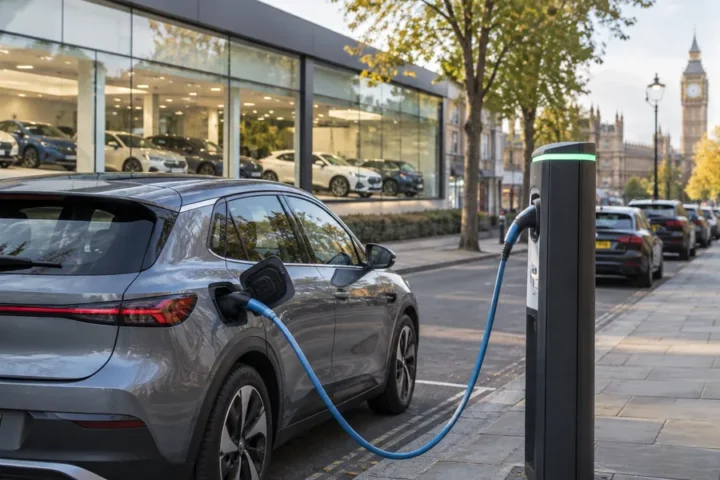
The UK government is considering easing requirements for new electric car sales, according to The Guardian, citing government sources. The newspaper reports that the 2030 target could fall from 80% to around 60%. A government spokesperson stressed, however, that no decisions had been made.
The report, published on 8 November, concerns the zero-emission vehicle (ZEV) mandate, which sets the proportion of manufacturers’ new car sales that must be zero-emission. According to The Guardian, the expected changes would include both a lower interim target for 2030 and an extension until 2034 of flexibility mechanisms that help manufacturers meet their obligations.
This is not an announced change in the rules. The government spokesperson quoted by the newspaper said ministers remained committed to the ZEV mandate. They also reaffirmed the commitments to end sales of new cars powered solely by petrol or diesel by 2030 and to ensure that all new cars and vans sold are zero-emission by 2035.
What would a lower target mean?
These commitments cover different parts of the transition. The 80% target for 2030 sets the required zero-emission share of new car sales. It is distinct from ending sales of new petrol-only and diesel-only cars, and from the goal of making all new car sales zero-emission in 2035. Reports that one requirement could be eased should therefore not be read as an announcement that the others are being abandoned.
According to the newspaper, the options under consideration include keeping the current rules, retaining the 80% target while extending the flexibility mechanisms, or reducing the 2030 requirement to 70%, 60% or 50%. The figure of around 60% cited by The Guardian’s sources remains a possible outcome, not an approved target.
Carmakers seek changes as charging industry warns of risks
The pace of electric car sales is central to the debate. Figures from the Society of Motor Manufacturers and Traders (SMMT), the UK automotive industry body, cited by The Guardian show that battery-electric cars accounted for 26.6% of new car sales in the first ten months of 2026. The nominal target for that year given in the report is 33%.
Comparing those two figures alone does not establish that manufacturers are failing to meet their obligations. The scheme includes flexibility mechanisms that can allow companies to avoid penalties even when the electric share of their sales is below the nominal target. The SMMT supports changing the trajectory of the targets and expanding those mechanisms, arguing that the current requirements are out of step with demand.
Some Labour MPs and representatives of the vehicle charging industry oppose weakening the targets. They warn that doing so could put investment and climate policy at risk. Those are the assessments of participants in the debate over future regulation, rather than established consequences of any change.
For drivers, the key distinction is between a possible easing of manufacturers’ obligations and the rules currently in place. The Guardian’s report describes a potential direction for government policy—not a decision that has already changed the timetable for new car sales.